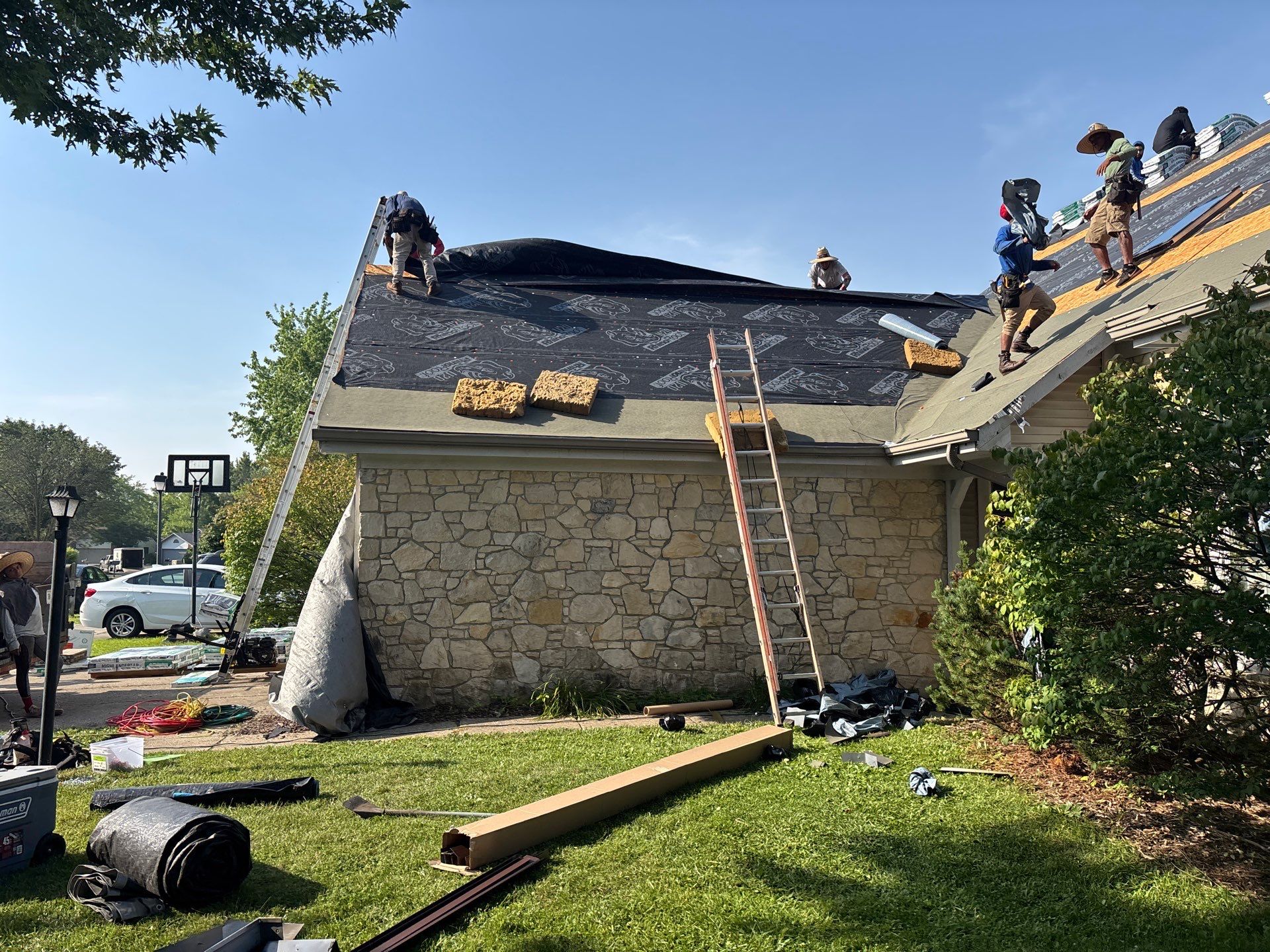
Why Tree Impacts Are Not Like Other Roof Damage
Hail and wind spread their force across a wide area. A tree concentrates kinetic energy into a single contact point, then drags secondary damage outward as branches scrape, bounce, or settle. That is why a relatively small limb can punch through decking while a much larger limb that lands flat on a strong section of roof leaves only cosmetic shingle loss. Mass matters less than the geometry of the strike. A pointed broken end acts like a chisel. A rounded trunk distributes load. Wet wood is heavier and more punishing than dry wood, and a tree that falls during a saturated spring storm in Hamilton or Hendricks County hits harder than the same tree would in August.
The location of impact matters just as much as the force. A hit over a load bearing wall transfers energy into the framing and usually leaves the deck intact. A hit over an open span between rafters has nothing to push back, so the deck flexes, cracks, and sometimes punches through. Strikes near valleys, ridges, and chimney flashings tend to cause leaks even when the visible damage looks minor, because those transitions rely on precise overlap that gets disturbed by any movement. We cover the leak chain in more detail in our guide to roof leak detection and repair, and the principles all apply here.
Species matters too, more than most homeowners realize. A silver maple limb of the same diameter as an oak limb weighs noticeably less and tends to shatter on impact, spreading energy across a wider footprint. Oak, hickory, and ash hold together and drive force into a single point. Pine is lighter but often falls with the entire crown intact, which means hundreds of small contact points dragging across shingles at once. When our Attica Roofing crews arrive at a Attica property, the first thing we ask after confirming everyone is safe is what kind of tree came down. That answer alone narrows the likely damage profile before we put a ladder up.
The Damage Comparison That Drives the Decision
Use this table the way our crews use it on site. Match what you can observe to the likely scope, then read the implications underneath before drawing any conclusions.
| Impact Scenario | Visible Signs | Likely Hidden Damage | Typical Scope | Insurance Pattern |
|---|---|---|---|---|
| Small limb, glancing blow | Scattered shingle granule loss, one or two creased tabs | Minimal, possible nail pops | Spot repair, 1 to 4 shingles | Often under deductible, no claim |
| Medium branch, direct strike, no penetration | Broken shingles in a 4 to 10 ft zone, bent flashing | Loosened nails, compressed underlayment, hairline deck cracks | Section repair, 1 to 2 squares | Claim usually worth filing |
| Large limb, penetration of decking | Visible hole, daylight in attic, wet insulation | Cracked decking around hole, displaced rafters, water tracking | Partial reroof of slope, deck replacement | Covered, deductible applies |
| Trunk or major fork across structure | Caved roof line, broken rafters, interior ceiling damage | Framing failure, sheathing destruction, possible wall damage | Full roof replacement with framing repair | Covered, often dwelling plus contents |
| Tree leaning on roof, not fully fallen | Crushed gutters, lifted shingles along contact line | Sustained pressure damage, ongoing deck stress | Tree removal first, then full assessment | Emergency tarp covered, scope set after removal |
Reading the Table Against Your Situation
The single biggest mistake homeowners make is settling on a scope before the tree is off the roof. A leaning tree is still actively damaging the structure every time the wind shifts, and the visible signs you see in hour one are almost never the final picture. Get an emergency tarp installed, document everything, and then decide. Our storm damage response calls in Attica usually start with that tarp and a written field report your adjuster can work from.
The second mistake is assuming penetration equals replacement and non penetration equals repair. Neither is reliable. We have seen clean punctures that needed only eight square feet of decking and twelve shingles. We have also seen unbroken roofs where the impact compressed the deck so badly that the entire slope had failed nail bonds and could not hold a new course of shingles. The only way to know is a full inspection, ideally with attic access so we can read the underside of the deck and the rafter condition. If the wood fibers are crushed but the surface is whole, that slope is on borrowed time.
Insurance scope is the third place homeowners get tripped up. A fallen tree claim has two parts: the tree removal and the structural repair. Some policies cap removal at a low figure, sometimes around 500 to 1000 dollars, which rarely covers the full cost of a large hardwood off a steep roof. The roof repair itself is usually covered at replacement cost minus your deductible, but only for the damaged areas the adjuster scopes. If matching shingles are unavailable, Attica law and most policies allow for broader replacement, which is where careful documentation pays off. Our walkthrough of storm damage insurance claims covers the documentation steps in detail.
Timing of the claim also shapes the outcome. Adjusters who walk a roof within a week of the event read damage differently than ones who arrive a month later, after rain has dried out and shingle creases have relaxed. If you can get an inspection on the books quickly and have a contractor present during the adjuster visit, the scope conversation goes faster and produces fewer disputed line items. We meet adjusters on site as a standard part of our process, because the difference between a fair scope and a thin one often comes down to who is pointing at what.
Finally, do not let cosmetic repairs paper over structural questions. If your roof is over fifteen years old and a tree just took out a third of one slope, replacing only that slope leaves you with mismatched aging across the rest of the system. Sometimes the right answer is a full replacement at deductible cost. Sometimes it is a clean section repair. We tell you which one your roof actually needs, even when that means recommending less work than you expected.
Why a Tree Strike Often Exposes Structural Damage
What sets tree damage apart from hail or wind is that the force is concentrated and downward, which is exactly the kind of load a roof structure is not built to take from a single point. A heavy limb or trunk can crack a rafter, split a truss, or punch the decking inward, and none of that is visible from the shingles above. This is why a tree strike so often turns out to be a structural question wearing a roofing disguise, and why the assessment has to include the attic and the framing, not just the surface. A Attica homeowner weighing repair against replacement after a strike should let the structural findings drive the decision, because a beautiful new slope over a cracked truss is no fix at all. Reading the comparison table against your own situation starts with knowing whether the framing took the hit, and that answer only comes from looking underneath. It is the difference between a repair that restores the roof and one that simply hides what the impact really did. We would rather spend an hour in the attic confirming the structure than sign off on a scope that leaves a homeowner with a hidden problem.